Why Experts Disagree About When Q-Day Will Happen
"There is large variability among the opinions of the experts: some lean towards optimism, while others are more cautious about the pace at which quantum computers will be developed."
- Global Risk Institute, Quantum Threat Timeline Report 2024
Hardware
Different quantum computing models use different physical approaches, including superconducting circuits, trapped ions, and photonic systems. Each approach has trade-offs. Some are easier to scale but harder to stabilize. Others may be more accurate but more difficult to manufacture at large scale.
Error Correction
Error correction is another major barrier.
Quantum bits, or qubits, are fragile. They can lose coherence quickly, which makes long calculations difficult. Breaking modern public-key cryptography would require large numbers of fault-tolerant logical qubits. That likely means millions of physical qubits working together to create a smaller number of reliable logical qubits.
Algorithmic Efficiency
Algorithmic progress also adds uncertainty. Breakthroughs in quantum algorithms could accelerate the timeline, while improvements in classical defenses and post-quantum standards could reduce risk.
In practical terms, experts disagree because they are assessing different breakthroughs. Some focus on physics. Others focus on engineering, error correction, or cryptographic math.
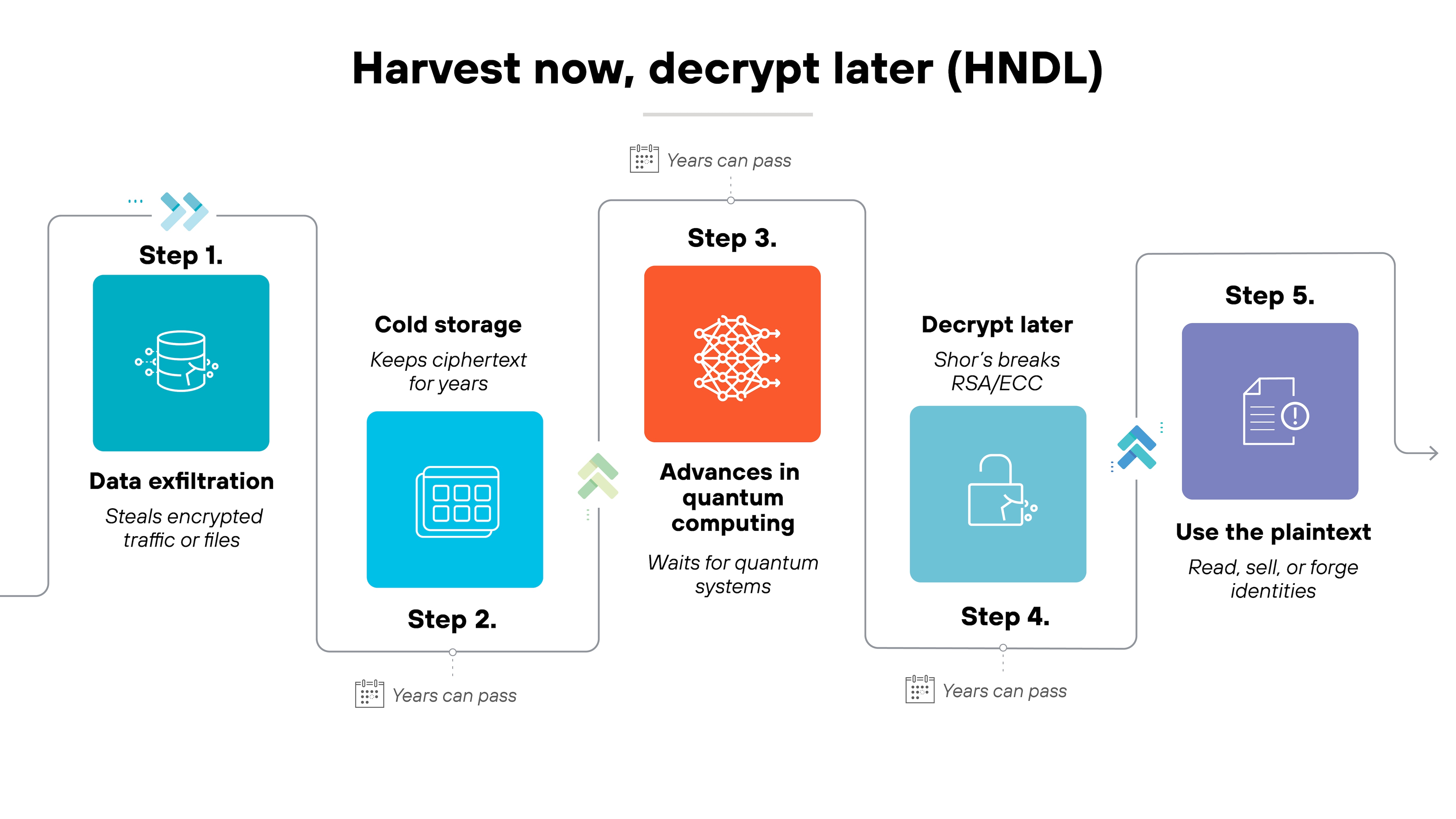
The exact date matters less than the preparation window. For security teams, the risk begins long before Q-Day because sensitive data can be stolen today and decrypted later.
What Would Happen If Q-Day Arrived Tomorrow?
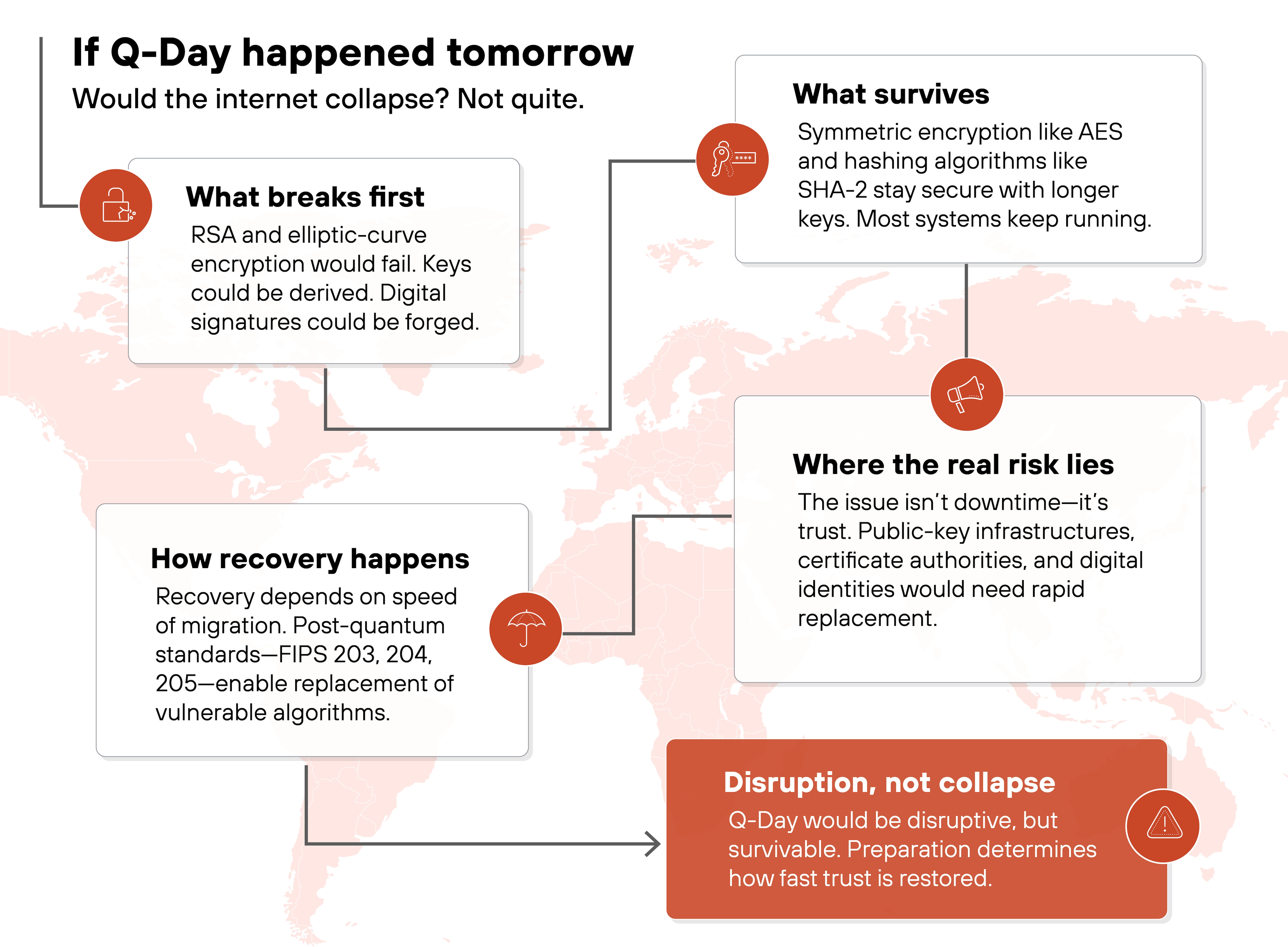
If Q-Day happened tomorrow, the internet would not simply go dark. But encryption based on RSA and elliptic-curve cryptography would no longer be trusted.
A CRQC could solve the mathematical problems that today’s public-key algorithms rely on. That means attackers could derive private keys, decrypt protected data, and forge digital signatures.
The first systems at risk would be those using older, static, or poorly managed keys. Systems protecting long-lived sensitive data would be especially exposed, including financial archives, intellectual property, government records, healthcare data, and confidential communications.
However, Q-Day would not instantly break all forms of encryption.
Symmetric encryption and hashing algorithms, such as AES and SHA-2, would remain more resilient when configured with appropriate key lengths. Many systems could continue operating, but the trust layer of the internet would be under pressure.
The largest issue would be verification.
Public key infrastructure, certificate authorities, digital certificates, signing systems, identity systems, and secure communications would need rapid migration to post-quantum cryptographic standards.
In short: Q-Day would cause disruption, not collapse. The severity would depend on how prepared organizations are to replace vulnerable algorithms, rotate keys, update certificates, and deploy quantum-resistant cryptography.
Recommended Reading: 8 Quantum Computing Cybersecurity Risks [+ Protection Tips]
Why Harvest-Now, Decrypt-Later Matters More Than Q-Day Itself
The biggest quantum security threat is not only what happens on Q-Day. It is what attackers can do before Q-Day arrives.
Harvest-now, decrypt-later is a threat model in which attackers steal encrypted data today and store it until quantum computers can decrypt it in the future. This creates immediate risk for data that must remain confidential for many years.
Examples include:
- Government records
- Defense and intelligence data
- Financial records
- Healthcare information
- Legal documents
- Trade secrets
- Product designs
- Research data
- Long-term identity records
The longer the confidentiality lifespan of the data, the greater the exposure.
This is why quantum readiness cannot wait until quantum computers are fully mature. Organizations need to protect sensitive data now so it remains secure later.
Unit 42 Perspective: Q-Day Risk Starts With Today’s Data Theft
Unit 42 insight: Q-Day is not only about future decryption capability. It is also about the sensitive data that adversaries can collect before that capability exists.
Q-Day is a future cryptographic milestone, but the exposure begins with present-day data theft. Unit 42’s 2026 Global Incident Response Report found that the fastest quartile of intrusions reached data exfiltration in 72 minutes in 2025, a sharp decrease from 285 minutes in 2024.
For security teams, this means Q-Day preparation cannot wait for quantum computers to mature. Sensitive encrypted data may already be leaving environments during fast-moving intrusions. If that data has a long confidentiality lifespan, it may remain valuable when cryptographically relevant quantum computers become available.
Unit 42 also reports that 87% of attacks unfolded across multiple attack surfaces, which reinforces the need for quantum readiness planning across endpoints, cloud, SaaS, identity, and network environments.
How Close Are We to Q-Day?
Q-Day is not imminent, but it is no longer theoretical.
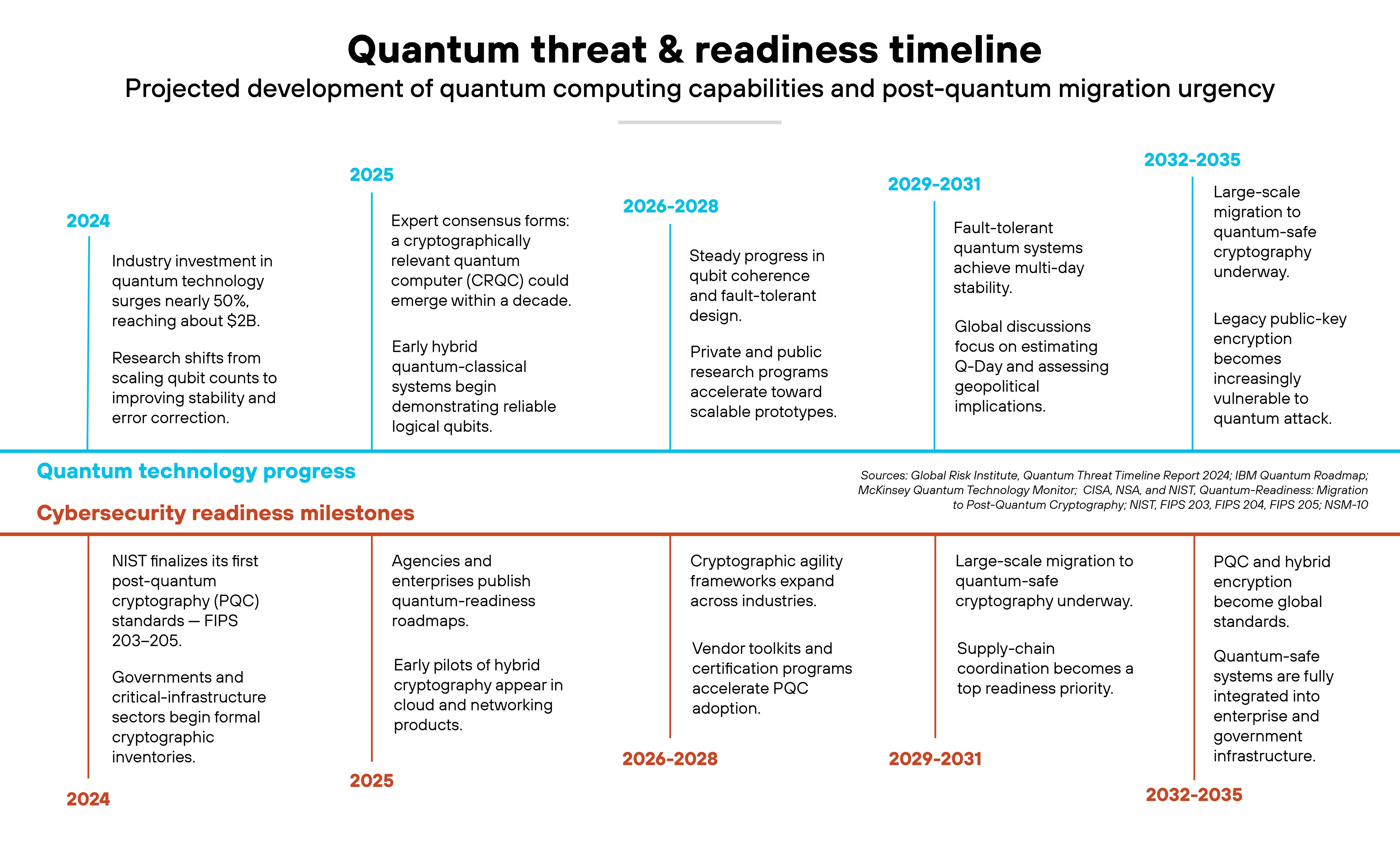
Most current expert assessments suggest that cryptographically relevant quantum computers are still years away, likely arriving in the 2030s or later. The challenge is not simply building more qubits. Quantum systems must also become stable, fault-tolerant, and capable of running long cryptographic attacks reliably.
Current quantum systems have made measurable progress in qubit quality, stability, and error correction. But they remain far from the scale needed to break RSA or elliptic-curve cryptography in real-world conditions.
At the same time, migration planning is already underway.
NIST finalized its first post-quantum cryptography standards in 2024:
- FIPS 203: Module-Lattice-Based Key-Encapsulation Mechanism, or ML-KEM
- FIPS 204: Module-Lattice-Based Digital Signature Standard, or ML-DSA
- FIPS 205: Stateless Hash-Based Digital Signature Standard, or SLH-DSA
These standards give governments, vendors, and enterprises a clearer path toward quantum-resistant cryptography.
The takeaway is straightforward: Q-Day is not expected tomorrow, but the migration window is already open.
Organizations that begin now will have time to inventory cryptography, assess risk, test post-quantum algorithms, coordinate with vendors, and migrate safely. Organizations that wait may face compressed timelines and higher exposure.
What Are Governments and Standards Bodies Doing to Prepare?
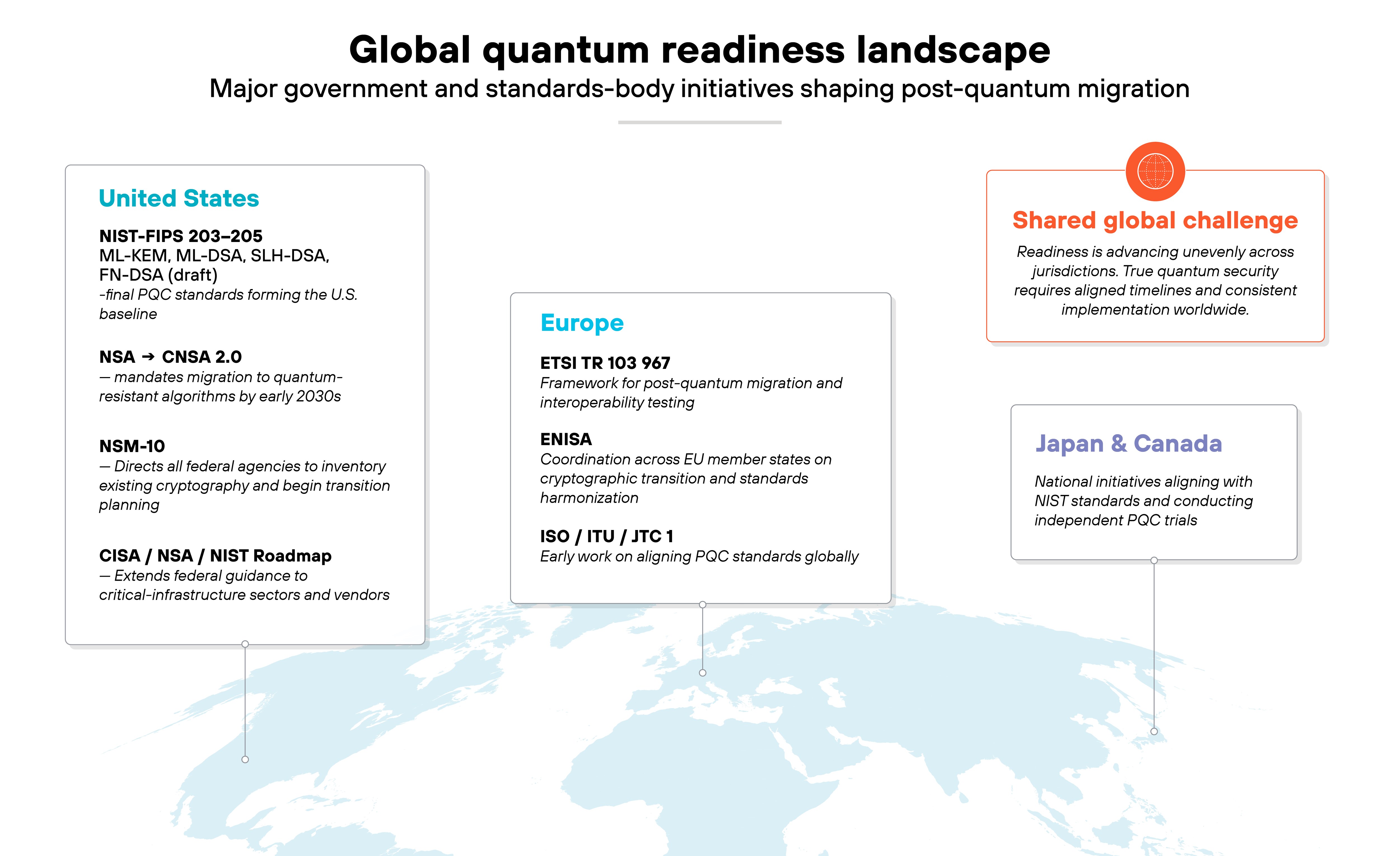
Governments and standards bodies are moving from research to implementation.
In the United States, NIST PQC standards establish approved algorithms for quantum-resistant key encapsulation and digital signatures.
Federal policy is also accelerating migration. U.S. agencies have been directed to inventory cryptographic systems, assess quantum risk, and prepare migration plans for post-quantum cryptography.
The NSA’s Commercial National Security Algorithm Suite 2.0, or CNSA 2.0, also provides guidance for national security systems transitioning to quantum-resistant algorithms.
Globally, organizations such as ENISA, ETSI, ISO, and other standards bodies are developing guidance for post-quantum migration, interoperability, testing, and implementation.
The direction is clear: Global standards are converging, migration timelines are emerging, and organizations are expected to begin planning now.
How to Prepare for Q-Day Without Overreacting
"A successful post-quantum cryptography migration will take time to plan and conduct. CISA, NSA, and NIST urge organizations to begin preparing now by creating quantum-readiness roadmaps, conducting inventories, applying risk assessments and analysis, and engaging vendors. Early planning is necessary as cyber threat actors could be targeting data today that would still require protection in the future (or in other words, has a long secrecy lifetime), using a catch now, break later or harvest now, decrypt later operation."
- NIST, NSA, CISA, Quantum-Readiness: Migration to Post-Quantum Cryptography
Preparing for Q-Day is not about panic. It is about disciplined security planning.
Organizations should begin with leadership, visibility, prioritization, testing, and governance.
1. Assign Ownership
Quantum readiness needs executive and technical ownership. Security leaders should define who is responsible for cryptographic risk, PQC migration planning, and progress reporting.
2. Build a Cryptographic Inventory
Organizations need to know where cryptography is used across applications, APIs, certificates, keys, cloud services, devices, infrastructure, and third-party systems.
Without this inventory, teams cannot prioritize migration or understand their true exposure.
3. Prioritize Long-Lived Sensitive Data
Data with a long confidentiality lifespan should be prioritized first. This includes information that would still be valuable or damaging if exposed 10, 20, or 30 years from now.
4. Assess Vendor Readiness
Many cryptographic dependencies exist in vendor-managed products and services. Procurement and security teams should ask vendors about their post-quantum roadmaps, crypto-agility, and support for NIST PQC standards.
5. Test Post-Quantum Cryptography
Organizations should pilot post-quantum and hybrid cryptographic approaches in controlled environments before broad deployment. Testing helps identify performance, interoperability, latency, and operational challenges.
6. Build Crypto-Agility
Crypto-agility is the ability to replace cryptographic algorithms, keys, certificates, and protocols without redesigning entire systems. It is one of the most important long-term capabilities for quantum readiness.
7. Create a Quantum Readiness Roadmap
A readiness roadmap should define owners, milestones, dependencies, technical priorities, vendor requirements, and migration timelines. The objective is not to replace every cryptographic system overnight. The objective is to make migration manageable before it becomes urgent.
Will Q-Day Be a Crisis or a Milestone?
Q-Day will not be a single moment when the internet collapses. It will be a milestone that reveals how well organizations are prepared.
Systems built with cryptographic visibility, crypto-agility, and post-quantum migration plans will be better positioned to adapt. Systems that rely on unknown cryptographic dependencies, legacy algorithms, and static keys will face greater disruption.
The transition to quantum-safe security is already underway. Standards exist. Timelines are emerging. Vendor roadmaps are being developed. The real challenge is execution.
Q-Day is not a surprise waiting to happen. It is a predictable security milestone. Whether it becomes a crisis depends on whether organizations start preparing now.
Explore the future of quantum security
Dive into an interactive overview of quantum threats, post-quantum cryptography, and NIST's new standards.
Q-Day FAQs