Search
Table of contents
- What Is Quantum Security? Preparing for the Post-Quantum Era
-
Harvest Now, Decrypt Later: Quantum Security Risk
- How Does a Harvest Now, Decrypt Later Attack Work?
- Unit 42 Perspective: Data Theft Is Already Moving Faster
- Why HNDL Matters Before Quantum Computers Exist
- Which Organizations and Data Are Most Exposed?
- How Attackers Exploit the Window Before PQC
- How HNDL Connects to Q-Day
- How to Prepare for Harvest-Now, Decrypt-Later Attacks
- How HNDL Fits Into a Broader Quantum Security Strategy
- HNDL FAQs
-
What Is Q-Day? Quantum Computing and Cyber Risk
- Why Experts Disagree About When Q-Day Will Happen
- What Would Happen If Q-Day Arrived Tomorrow?
- Why Harvest-Now, Decrypt-Later Matters More Than Q-Day Itself
- Unit 42 Perspective: Q-Day Risk Starts With Today’s Data Theft
- How Close Are We to Q-Day?
- What Are Governments and Standards Bodies Doing to Prepare?
- How to Prepare for Q-Day Without Overreacting
- Will Q-Day Be a Crisis or a Milestone?
- Q-Day FAQs
- NIST PQC Migration Strategies: Steps, Standards & Tips
-
What Is Post-Quantum Cryptography (PQC)? A Complete Guide
- Post-Quantum Cryptography Explained
- The Quantum Threat to Modern Encryption
- How Post-Quantum Cryptography Works
- Standardized Algorithms: NIST FIPS 203, 204, and 205
- Preparing for the Post-Quantum Transition
- PQC Challenges and Implementation Pitfalls
- How Can Organizations Prepare for PQC?
- Post-Quantum Cryptography FAQs
-
What Are NIST PQC Standards?
- NIST PQC Standards Explained
- The Urgency of Quantum-Resistant Cryptography
- What Is the Timeline for PQC Adoption?
- Core NIST PQC Standards and Finalized Algorithms
- What PQC Standards Exist Today?
- How Do Global PQC Standards and Policies Differ?
- What Is Hybrid Cryptography?
- How NIST PQC Standards Differ from Classical Encryption
- Strategic Migration: Implementing NIST PQC Standards
- Unit 42 Insights: The Evolving Threat Landscape
- Overcoming PQC Implementation Challenges
- PQC Readiness: What to Do Now
- Quantum security FAQs
-
8 Quantum Computing Cybersecurity Risks + How to Prepare
- What Are Quantum Computing Cybersecurity Risks?
- Why Quantum Computing Threatens Cybersecurity
- 1. Breaking Public-Key Encryption
- 2. Harvest-Now, Decrypt-Later Attacks
- 3. Forgery of Digital Signatures
- 4. Compromise of Secure Boot Processes
- 5. Vulnerability of Financial Transactions and Ledgers
- 6. Decryption of Historical Data Backups
- 7. Identity and Access Management Failure
- 8. Obsolescence of Legacy IoT and Embedded Systems
- Quantum Threat and Readiness Timeline
- How Organizations Can Prepare For Quantum Cybersecurity Risks
- Quantum Computing Cybersecurity Risk Examples
- What changed recently in post-quantum cybersecurity?
- Quantum Computing Cybersecurity Risks FAQs
What Is Quantum Readiness?
7 min. read
Table of contents
Quantum readiness is an organization’s ability to prepare for and transition from today’s cryptographic systems to post-quantum security. It requires knowing where cryptography is used, identifying systems and data most exposed to quantum risk, and building a practical migration plan for quantum-resistant algorithms.
Quantum readiness is not a single technology upgrade. It is a coordinated security, governance, and risk management effort that helps organizations replace vulnerable encryption safely, predictably, and at scale.

Key Points
-
Quantum readiness prepares organizations for post-quantum cryptography: It helps security teams identify cryptographic dependencies, assess risk, and plan migration before quantum-capable attacks become practical. -
Harvest-now, decrypt-later attacks create urgency: Adversaries can steal encrypted data today and store it until quantum computers are powerful enough to decrypt it later. -
Crypto-agility is essential: Organizations need the ability to replace cryptographic algorithms without redesigning every application, device, or system. -
Migration will take years: Cryptographic discovery, vendor coordination, testing, and implementation require long-term planning across IT, security, legal, procurement, and compliance teams. -
Global timelines are converging around the 2030s: NIST finalized its first three post-quantum cryptography standards in 2024, and the UK NCSC has published migration milestones for 2028, 2031, and 2035.
Why Quantum Readiness Matters Now
Quantum computers powerful enough to break today’s widely used public-key encryption do not exist yet. But the security risk is already real.
Attackers can use harvest-now, decrypt-later tactics to collect encrypted traffic, sensitive records, intellectual property, or classified data today. Once a cryptographically relevant quantum computer becomes available, the stored data could become readable.
That matters because some data must remain confidential for years or decades. Health records, financial information, government data, trade secrets, and long-lived intellectual property may still be valuable when quantum decryption becomes possible.
Post-quantum migration also takes time. Most organizations do not yet have a complete inventory of where cryptography is used across applications, APIs, devices, cloud services, certificates, embedded systems, and third-party integrations. Without that visibility, they cannot accurately prioritize or execute a migration plan.
Government policy and standards are also moving the timeline forward. NIST finalized FIPS 203, FIPS 204, and FIPS 205 in 2024 as the first three post-quantum cryptography standards. These standards define quantum-resistant approaches for key encapsulation and digital signatures.
The bottom line: Quantum readiness is not theoretical preparation. It is secure-by-design modernization for the next era of cryptography.
Recommended Reading:
Unit 42 Perspective: Visibility Gaps Increase Quantum Risk
Unit 42 insight: Quantum readiness is not only a cryptography project. It is a visibility, identity, data protection, and risk prioritization challenge.
Quantum readiness starts with knowing where sensitive data, cryptography, identities, and systems are exposed. Unit 42’s 2026 Global Incident Response Report found that 87% of attacks unfolded across multiple attack surfaces, making it harder for organizations to correlate attack signals across endpoints, cloud, SaaS, identity, and networks.
That complexity matters for post-quantum migration. Organizations cannot prioritize cryptographic risk if they do not know where sensitive data moves, which systems protect it, or where vulnerable encryption is used.
Unit 42 also found that identity-based techniques drove 65% of initial access, showing how quickly attackers can exploit trust relationships to move through environments. For quantum readiness, this reinforces the importance of protecting digital trust systems, certificates, identities, keys, and authentication flows as part of cryptographic modernization.
The Five Pillars of Quantum Readiness
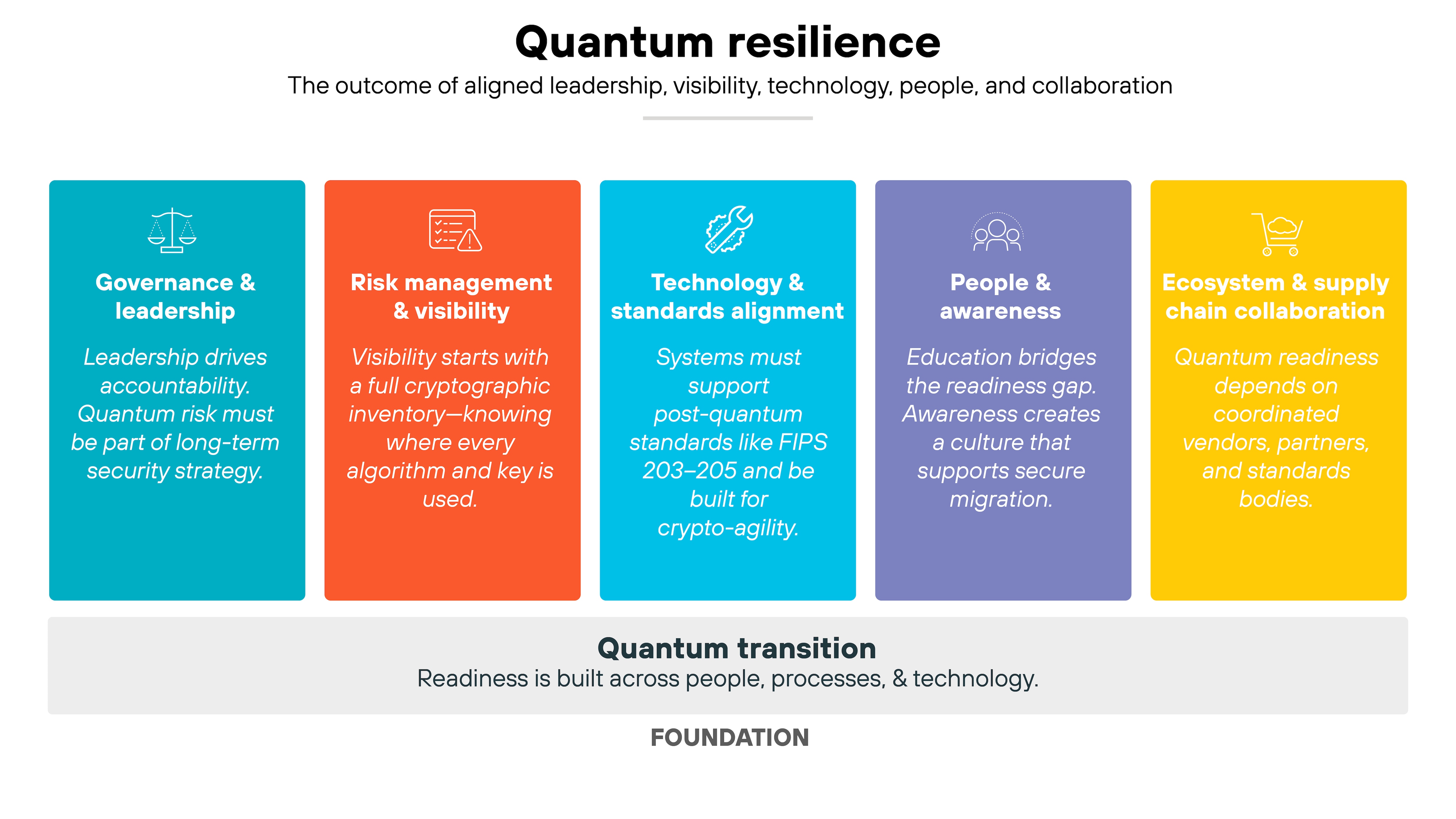
Quantum readiness is built across people, processes, technology, and the broader digital ecosystem. The following five pillars provide a practical model for preparing an organization for post-quantum migration.
Pillar 1: Governance and Leadership
Quantum readiness starts with executive ownership.
Post-quantum migration affects security architecture, infrastructure, vendor relationships, compliance obligations, and long-term risk management. It cannot be managed as a side project or isolated research effort.
A strong governance model defines who owns the quantum readiness program, how migration decisions are made, and how progress is measured. This usually includes a cross-functional steering group with leaders from security, IT, risk, legal, procurement, and business operations.
The goal is to make quantum risk part of the organization’s broader cyber resilience strategy.
Pillar 2: Risk Management and Cryptographic Visibility
Organizations cannot protect what they cannot see.
Cryptographic visibility is one of the most important foundations of quantum readiness. Security teams need to identify where encryption, digital signatures, key exchange, certificates, and cryptographic libraries are used across the environment.
A cryptographic inventory should include:
- Applications and APIs
- Public key infrastructure
- Certificates and keys
- Cloud services
- Network devices
- IoT, OT, and embedded systems
- Third-party software and vendor platforms
- Machine-to-machine connections
Once this inventory exists, teams can prioritize systems based on data sensitivity, business criticality, exposure, and data lifespan.
Systems that protect long-lived or high-value data should move to the front of the migration roadmap.
Pillar 3: Technology and standards alignment
Technology readiness means ensuring systems can support post-quantum cryptography and adapt as standards evolve.
NIST’s first finalized PQC standards are:
These standards give organizations a clearer path for testing and implementing quantum-resistant cryptography.
Technology alignment also requires crypto-agility, which is the ability to replace cryptographic algorithms, protocols, and libraries without rearchitecting entire systems. Crypto-agility helps organizations respond when standards change, vulnerabilities are discovered, or new algorithms become required.
Pillar 4: People and Awareness
Quantum readiness is not only a technical challenge. It is also an education and change management challenge.
Security leaders, engineers, developers, architects, risk teams, and procurement teams need to understand how quantum risk affects their responsibilities. Training should focus on practical implications, not abstract quantum physics.
For example:
- Developers need to know where cryptographic libraries are embedded in applications.
- Infrastructure teams need to understand certificate and key dependencies.
- Procurement teams need to ask vendors about PQC roadmaps and crypto-agility.
- Executives need enough context to fund migration and track risk reduction.
Awareness turns quantum readiness from a technical concept into an organizational capability.
Pillar 5: Ecosystem and supply chain collaboration
Ecosystem and Supply Chain Collaboration
No organization becomes quantum-ready alone.
Modern cryptography and quantum migration are deeply connected across vendors, suppliers, cloud providers, managed service providers, open-source software, and third-party platforms. A single vendor using vulnerable cryptography can introduce risk into a broader environment.
Organizations should ask vendors:
- Which cryptographic algorithms are used in your products?
- Do you have a post-quantum migration roadmap?
- Which NIST PQC standards do you plan to support?
- How will updates be delivered?
- Does your product support crypto-agility?
- Can customers identify and manage cryptographic dependencies?
Quantum security isn't achieved in isolation. It's built together, through coordination and shared accountability across the digital supply chain.
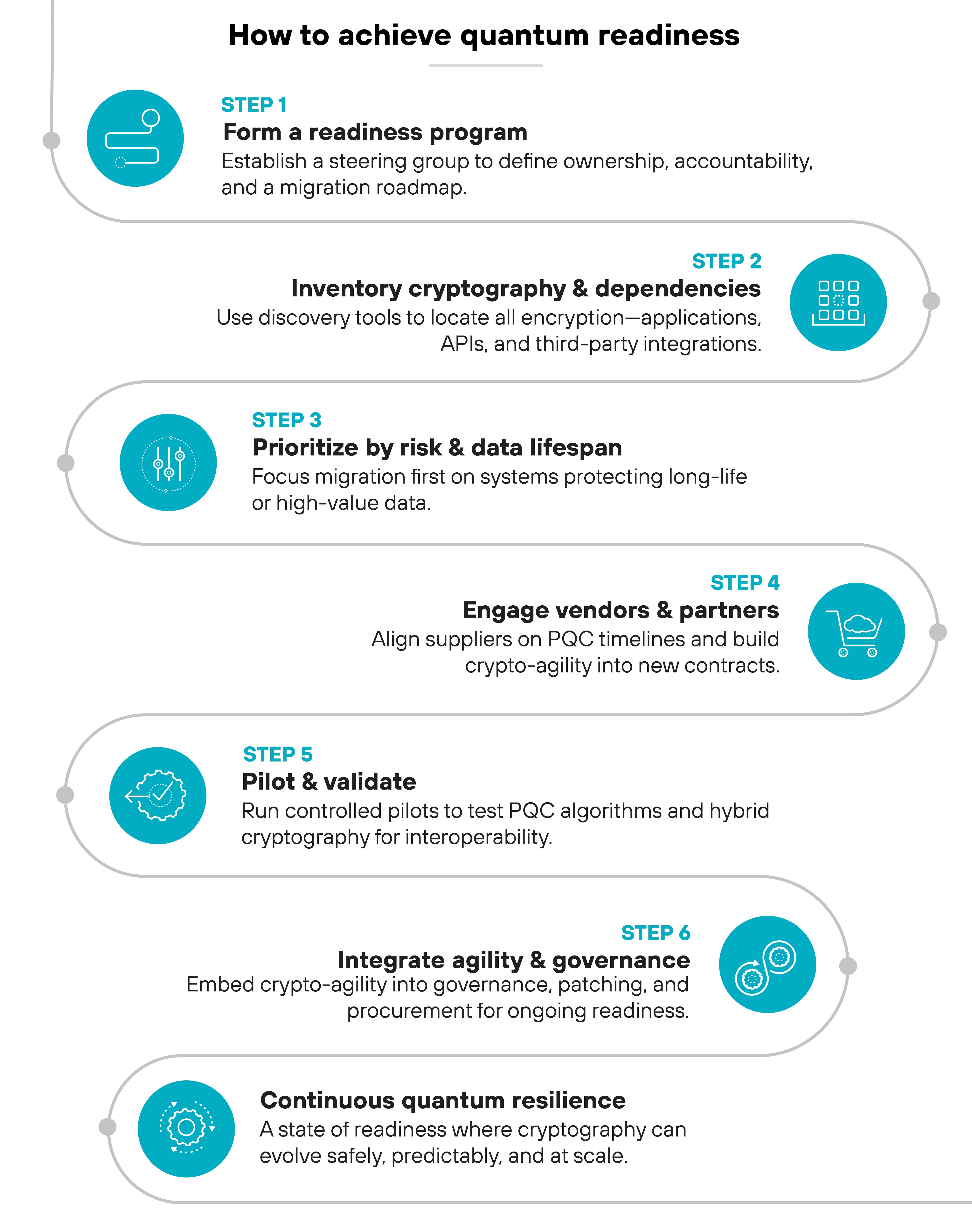
How to Achieve Quantum Readiness in 6 Steps
Moving from awareness to execution requires a structured roadmap. These six steps help organizations begin preparing for post-quantum cryptography.
Step 1: Create a Quantum Readiness Program
Start by forming a cross-functional readiness team.
Include representatives from security, IT, infrastructure, application development, procurement, legal, compliance, and risk management. This team should define the scope of the program, assign ownership, and create a roadmap for cryptographic discovery, prioritization, testing, and migration.
Treat quantum readiness as part of enterprise risk management, not an experimental research initiative.
Step 2: Inventory Cryptography and Dependencies
Identify where cryptography is used across the environment.
This includes encryption algorithms, key exchange mechanisms, certificates, signing methods, cryptographic libraries, protocols, and vendor-managed systems. Discovery should cover applications, APIs, devices, cloud workloads, network infrastructure, and third-party integrations.
The output should be a living cryptographic inventory that maps cryptographic assets to business systems, data classifications, and risk levels.
Step 3: Prioritize Systems by Risk and Data Lifespan
Not every system needs to migrate at the same time.
Prioritize systems that protect sensitive data with a long confidentiality lifespan. This may include government data, healthcare records, financial records, intellectual property, critical infrastructure data, or regulated information.
High-priority systems usually share three traits:
- They use quantum-vulnerable public-key cryptography.
- They protect high-value or long-lived data.
- They are critical to business, mission, or regulatory operations.
This risk-based approach enables organizations to focus their resources where quantum exposure is highest.
Step 4: Engage Vendors and Partners
Post-quantum migration extends beyond internal systems.
Organizations should work with vendors, suppliers, and service providers to understand their PQC plans. Procurement teams should include crypto-agility and PQC support in new contracts, renewals, and security questionnaires.
Vendor engagement should begin early, as supplier timelines may impact enterprise migration plans.
Step 5: Pilot and Validate Post-Quantum Cryptography
Before broad deployment, test post-quantum algorithms in controlled environments.
Pilot projects help teams evaluate performance, interoperability, latency, certificate handling, key exchange behavior, and integration complexity. Many organizations will need to test hybrid cryptographic models that combine classical and quantum-resistant methods during transition periods.
Testing should begin in non-production environments that mirror real-world traffic patterns and system dependencies.
Step 6: Build Crypto-Agility into Governance
Quantum readiness should become continuous.
Organizations should update governance, procurement, patching, and architecture policies to require crypto-agility. They should also add quantum risk metrics to security reporting and audit processes.
The objective is not simply to complete one migration. The objective is to make cryptographic change manageable over time.

EBOOK: NAVIGATING THE QUANTUM SHIFT - A PRACTICAL ROADMAP
Learn what quantum risk means for your organization and how to prepare in practice.
Download eBookGlobal Quantum Readiness Timelines and Mandates
Quantum readiness is increasingly shaped by formal standards, government policy, and national migration timelines.
In the United States, NIST finalized its first three post-quantum cryptography standards in 2024. These standards provide a foundation for federal and commercial adoption of quantum-resistant algorithms.
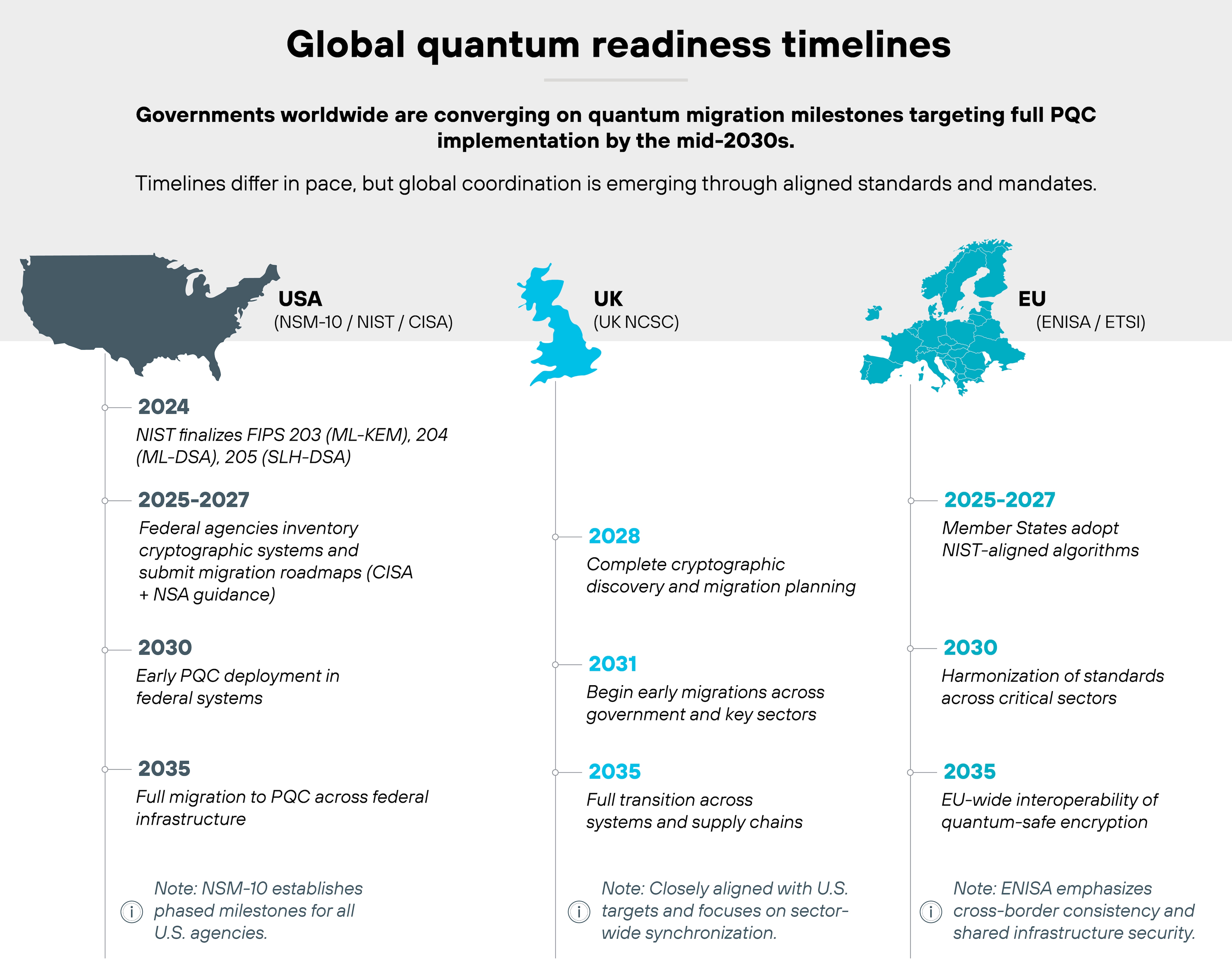
The United Kingdom’s National Cyber Security Centre has published a phased PQC migration timeline:
- By 2028: Define migration goals, complete cryptographic discovery, and build an initial migration plan.
- By 2031: Begin early, high-priority migration activities and refine the roadmap.
- By 2035: Complete migration to post-quantum cryptography across systems, services, and products.
Across regions, the direction is clear: Organizations are being pushed from awareness into planning, testing, and execution.
The exact requirements may vary by country and sector, but the strategic mandate is consistent: Begin preparing now so cryptographic migration can happen before quantum risk becomes operationally urgent.
Recommended Reading: What Is Q-Day, and How Far Away Is It—Really?
What Comes Next for Quantum Readiness?
Quantum readiness does not end when migration begins.
As algorithms, standards, products, and attack models evolve, organizations will need ongoing cryptographic lifecycle management. That means continuously monitoring cryptographic assets, updating algorithms, managing keys, validating compliance, and coordinating across vendors and industry bodies.
The organizations best positioned for the quantum era will be those that build agility now. They will know where cryptography exists, understand which systems carry the greatest risk, and have the governance structure needed to update encryption without disruption.
Organizations that wait will face a harder problem later: compressed timelines, unclear dependencies, vendor bottlenecks, and higher exposure to harvest-now, decrypt-later risk.
Quantum readiness is the practical path to quantum resilience.

Get your quantum readiness assessment
The assessment includes:- Overview of your cryptographic landscape
- Quantum-safe deployment recommendations
- Guidance for securing legacy apps & infrastructure
Quantum readiness FAQs
Quantum readiness is the ability to prepare for and transition to post-quantum security. It includes identifying where cryptography is used, assessing exposure to quantum-vulnerable algorithms, prioritizing systems for migration, and building crypto-agility so encryption can be updated safely as standards evolve.
Quantum readiness is important because future quantum computers may be able to break widely used public-key cryptography. Attackers can also steal encrypted data now and decrypt it later when quantum capabilities mature. Organizations need time to inventory systems, assess risk, test post-quantum algorithms, and coordinate migration.
Organizations become quantum ready by creating a readiness program, building a cryptographic inventory, prioritizing high-risk systems, engaging vendors, piloting post-quantum cryptography, and embedding crypto-agility into governance and procurement processes.
Crypto-agility is the ability to replace cryptographic algorithms, protocols, certificates, or libraries without redesigning entire systems. It helps organizations adapt when standards change, new vulnerabilities emerge, or post-quantum cryptography becomes required.
A cryptographic inventory is a detailed record of where and how cryptography is used across an organization. It may include algorithms, certificates, keys, libraries, protocols, applications, APIs, devices, cloud services, and third-party dependencies.
NIST’s first finalized post-quantum cryptography standards are FIPS 203 for ML-KEM, FIPS 204 for ML-DSA, and FIPS 205 for SLH-DSA. These standards provide quantum-resistant mechanisms for key encapsulation and digital signatures.
The first step is to establish ownership and begin cryptographic discovery. Organizations need a readiness team and a clear inventory of where cryptography is used before they can assess risk or plan migration.
Organizations should start now. Post-quantum migration can take years because cryptography is often embedded across applications, infrastructure, devices, vendor products, and supply chains. Waiting until quantum attacks become practical will leave too little time for safe migration.


