Search
Table of contents
-
Harvest Now, Decrypt Later: Quantum Security Risk
- How Does a Harvest Now, Decrypt Later Attack Work?
- Unit 42 Perspective: Data Theft Is Already Moving Faster
- Why HNDL Matters Before Quantum Computers Exist
- Which Organizations and Data Are Most Exposed?
- How Attackers Exploit the Window Before PQC
- How HNDL Connects to Q-Day
- How to Prepare for Harvest-Now, Decrypt-Later Attacks
- How HNDL Fits Into a Broader Quantum Security Strategy
- HNDL FAQs
- Quantum Readiness: How to Prepare for Post-Quantum Security
-
What Is Q-Day? Quantum Computing and Cyber Risk
- Why Experts Disagree About When Q-Day Will Happen
- What Would Happen If Q-Day Arrived Tomorrow?
- Why Harvest-Now, Decrypt-Later Matters More Than Q-Day Itself
- Unit 42 Perspective: Q-Day Risk Starts With Today’s Data Theft
- How Close Are We to Q-Day?
- What Are Governments and Standards Bodies Doing to Prepare?
- How to Prepare for Q-Day Without Overreacting
- Will Q-Day Be a Crisis or a Milestone?
- Q-Day FAQs
- NIST PQC Migration Strategies: Steps, Standards & Tips
-
What Is Post-Quantum Cryptography (PQC)? A Complete Guide
- Post-Quantum Cryptography Explained
- The Quantum Threat to Modern Encryption
- How Post-Quantum Cryptography Works
- Standardized Algorithms: NIST FIPS 203, 204, and 205
- Preparing for the Post-Quantum Transition
- PQC Challenges and Implementation Pitfalls
- How Can Organizations Prepare for PQC?
- Post-Quantum Cryptography FAQs
-
What Are NIST PQC Standards?
- NIST PQC Standards Explained
- The Urgency of Quantum-Resistant Cryptography
- What Is the Timeline for PQC Adoption?
- Core NIST PQC Standards and Finalized Algorithms
- What PQC Standards Exist Today?
- How Do Global PQC Standards and Policies Differ?
- What Is Hybrid Cryptography?
- How NIST PQC Standards Differ from Classical Encryption
- Strategic Migration: Implementing NIST PQC Standards
- Unit 42 Insights: The Evolving Threat Landscape
- Overcoming PQC Implementation Challenges
- PQC Readiness: What to Do Now
- Quantum security FAQs
-
8 Quantum Computing Cybersecurity Risks + How to Prepare
- What Are Quantum Computing Cybersecurity Risks?
- Why Quantum Computing Threatens Cybersecurity
- 1. Breaking Public-Key Encryption
- 2. Harvest-Now, Decrypt-Later Attacks
- 3. Forgery of Digital Signatures
- 4. Compromise of Secure Boot Processes
- 5. Vulnerability of Financial Transactions and Ledgers
- 6. Decryption of Historical Data Backups
- 7. Identity and Access Management Failure
- 8. Obsolescence of Legacy IoT and Embedded Systems
- Quantum Threat and Readiness Timeline
- How Organizations Can Prepare For Quantum Cybersecurity Risks
- Quantum Computing Cybersecurity Risk Examples
- What changed recently in post-quantum cybersecurity?
- Quantum Computing Cybersecurity Risks FAQs
What Is Quantum Security?
6 min. read
Table of contents
Quantum security is a field of cybersecurity focused on protecting digital infrastructure and data from the unique threats posed by quantum computers. While classical computers use bits (0s and 1s), quantum computers use qubits, which can exist in multiple states simultaneously. This allows them to perform complex mathematical calculations, specifically those used to break current encryption standards, at speeds impossible for classical machines.
The Two Pillars of Defense:
Post-Quantum Cryptography (PQC): Software-deployable algorithms designed to run on classical systems while resisting both classical and quantum attacks. This is the primary migration path for most organizations.
- Quantum Cryptography (Physics-Based): Technologies like Quantum Key Distribution (QKD) and Quantum Random Number Generators (QRNG) that use the laws of physics (such as the observer effect) to secure data. These currently require specialized hardware and are used in high-assurance environments such as defense and telecom.
Prepare for the Post-Quantum Era
Quantum computing represents a paradigm shift in processing power and a total disruption of modern encryption. Whether you are just learning about "Q-Day" or looking to audit your current infrastructure, use the resources below to secure your data against the quantum threat.
- Step 1: Take the 2-minute Quantum Readiness Assessment.
- Step 2: Download the PQC Implementation Roadmap.
- Step 3: Speak with a Quantum Security Expert.
Key Points
-
Cryptographic Agility: The ability to seamlessly transition from legacy algorithms to quantum-resistant standards is a critical strategic requirement for modern enterprises. -
Harvesting Protection: Immediate migration to quantum-safe protocols is necessary to protect sensitive data from "harvest now, decrypt later" attacks by adversaries. -
Mathematical Resilience: Post-quantum cryptography relies on complex algebraic structures, such as lattices, that remain computationally infeasible for both classical and quantum systems to solve. -
Physical Detection: Quantum key distribution utilizes the observer effect to provide a physical layer of security where any attempt to intercept data disturbs its quantum state. -
NIST Compliance: Organizations must align with emerging FIPS standards for quantum-resistant algorithms to maintain regulatory compliance and secure their digital supply chains.
Why Modern Encryption is at Risk
Most digital trust today relies on Public-Key Cryptography (RSA and ECC). These systems are based on the difficulty of factoring large integers or solving discrete logarithms.

- Shor’s Algorithm: A quantum algorithm that can factor large numbers in minutes. If a large-scale, fault-tolerant quantum computer is built, RSA and ECC will be broken instantly.
- Grover’s Algorithm: Impacts symmetric encryption (AES). While it doesn't break it, it reduces effective key strength by half (e.g., AES-128 becomes AES-64). Solution: Transition to AES-256 to maintain security.

The Immediate Threat: Harvest Now, Decrypt Later (HNDL)

You cannot wait for "Q-Day" (the day a viable quantum computer exists) to act. Adversaries are currently executing HNDL attacks: stealing encrypted data today to decrypt it later.
They are capturing and storing encrypted sensitive data, intending to decrypt it once a fault-tolerant quantum computer exists. If your data has a shelf life of 10+ years (health records, state secrets, financial contracts), it is at risk now. The right question is not “When will quantum computers arrive?” The right question is “Which data and systems would still need protection when they do?”
"While it's true that experts predict it could be more than a decade before quantum computers can crack existing encryption, the time for cybersecurity preparations is now. The potential threat of quantum computing to existing encryption demands immediate action. Organizations are strongly advised to implement defense-in-depth strategies, prioritize data protection during both transmission and storage, and most importantly, remain adaptable in the face of new threats."
- S. B. Goyal, Vidyapati Kumar, Sardar M. N. Islam, Deepika Ghai (Eds.),
Quantum Computing, Cyber Security and Cryptography
Migrating cryptographic systems takes years. Algorithms need to be integrated into protocols, tested for performance, and deployed across vast infrastructures. Certificates and keys in public key infrastructures also have to be replaced. None of this can be done quickly.
The inflection point may not be pinned to a calendar. But the danger is already looming.
Organizations that begin preparing now will be ready when quantum computers reach scale. Those who wait risk being caught unprotected with years of work still ahead.
| Threat Component | Description | Risk Level |
|---|---|---|
| Q-Day | The point at which quantum computers break RSA/ECC encryption. | Critical (Future) |
| HNDL | Interception of data now for future decryption. | Immediate |
| Crypto-Agility | Lack of ability to rapidly switch encryption algorithms. | High (Ongoing) |
The New Standard: NIST FIPS Algorithms
PQC supports the same basic security functions organizations rely on today, including key establishment, digital signatures, authentication, and secure communications. It avoids the mathematical weaknesses that quantum computers are expected to exploit.

Instead of relying on factoring or discrete logarithms, many PQC algorithms use mathematical problems believed to be difficult for quantum computers, such as lattice-based problems and hash-based constructions.
"There is no need to wait for future standards. Go ahead and start using these three. We need to be prepared in case of an attack that defeats the algorithms in these three standards, and we will continue working on backup plans to keep our data safe. But for most applications, these new standards are the main event."
- NIST, Dustin Moody, Mathematician,
NIST Releases First 3 Finalized Post-Quantum Encryption Standards
The standards community, led by NIST, has finalized the first three PQC standards. These are the mandatory targets for future-proofing. These standards give organizations and vendors a concrete path for migration planning, testing, and implementation:
- ML-KEM (formerly Kyber): The standard for key establishment and general encryption.
- ML-DSA (formerly Dilithium): The primary standard for digital signatures.
- SLH-DSA (formerly SPHINCS+): A stateless hash-based signature scheme used as a resilient backup.
Note: "Quantum security" refers either to using quantum tech (like quantum key distribution) to boost cybersecurity or, as focused on here: how to protect current data and communications from future quantum computer threats.
Where Do QKD and QRNG Fit Into Quantum Security?
QKD and QRNG are often discussed alongside quantum security, but they are not the same as post-quantum cryptography.

QKD uses quantum states, such as photons, to help two parties exchange encryption keys. If an eavesdropper interferes with the exchange, the quantum state changes and the sender and receiver can detect the disturbance.

QRNGs harness unpredictable quantum processes to generate random numbers. Since cryptography depends on strong randomness, QRNGs can strengthen entropy sources for certain hardware security modules, secure communications systems, and other specialized environments.
While both technologies are advancing, their adoption remains concentrated in specialized use cases. For most organizations, PQC offers the most practical, software-deployable path to quantum-safe security today, while QKD and QRNG continue to evolve as complementary technologies for high-assurance environments.
Overcoming the Quantum Security Migration Challenge
Organizations are beginning with preparation, not wholesale replacement. Transitioning to a quantum-safe state is more complex than a typical software patch. It is not a one-click upgrade. Cryptography is embedded across applications, APIs, certificates, identity systems, hardware, firmware, cloud services, VPNs, IoT devices, and third-party integrations.

1. The Migration & Discovery Complexity
Encryption is not a standalone product; it is deeply embedded in nearly every layer of an enterprise’s infrastructure, from web servers and databases to proprietary code and third-party SaaS applications.
- The Inventory Gap: Most organizations don’t have a comprehensive "Cryptographic Bill of Materials" (CBOM). They simply don't know exactly where RSA or ECC algorithms are hiding within their legacy systems.
- Supply Chain Dependencies: Even if an enterprise updates its own systems, it remains vulnerable if its vendors, partners, or service providers haven't also migrated to PQC.
2. Lack of Cryptographic Agility
Most current security architectures were built with a "hard-coded" approach to encryption. Switching an algorithm usually requires re-engineering entire applications rather than simply toggling a setting.
- Structural Rigidity: Achieving Cryptographic Agility, the ability to rapidly switch between different cryptographic standards without a complete system overhaul, is a massive engineering hurdle.
- Standards Evolution: Because NIST standards are still being finalized and tested, organizations need the flexibility to swap out an algorithm if a specific PQC method is vulnerable in the future.
3. Performance and Hardware Hurdles
Post-quantum algorithms rely on much more complex mathematical problems than classical encryption. This complexity comes with a physical cost.
- Computational Overhead: PQC algorithms (like lattice-based cryptography) often require significantly larger encryption keys and more processing power. This can lead to increased latency in high-volume environments like financial trading or telecommunications.
- Constrained Devices: Older hardware, IoT devices, and industrial sensors often lack the CPU and memory capacity to handle the increased demands of PQC, potentially requiring expensive hardware refreshes across the entire digital estate.
How to Start a Quantum Security Readiness Plan
Quantum security planning should start with visibility and prioritization. Most organizations do not need to replace every cryptographic dependency immediately, but they do need to know where those dependencies exist and which systems create the greatest long-term exposure.
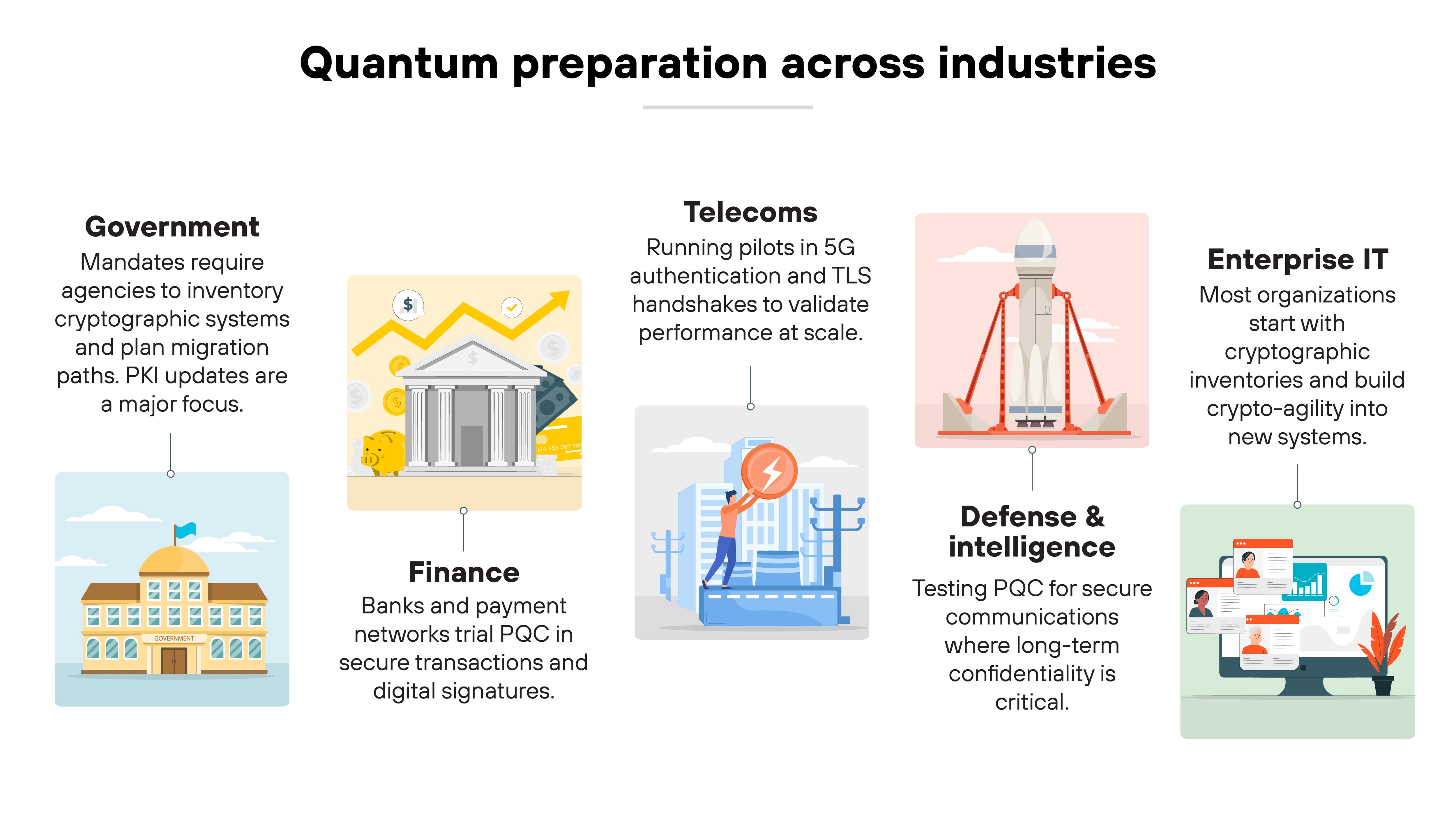
- Inventory cryptographic assets: Identify where RSA, ECC, certificates, keys, TLS, VPNs, APIs, firmware, and embedded cryptographic libraries are used.
- Prioritize long-life data: Focus first on data that must remain confidential for years or decades.
- Assess HNDL exposure: Determine where encrypted data could be intercepted today and still hold value in the future.
- Test PQC and hybrid models: Validate performance, compatibility, and operational impact in controlled environments.
- Build cryptographic agility: Design systems to rotate keys, certificates, algorithms, and protocols without major disruption.
- Coordinate with vendors: Ask software, hardware, cloud, and security vendors about their PQC roadmaps and migration support.
- Create a phased migration roadmap: Sequence updates based on risk, system criticality, compliance requirements, and business continuity.

Get your quantum readiness assessment.
- Overview of your cryptographic landscape
- Quantum-safe deployment recommendations
- Guidance for securing legacy apps & infrastructure
Quantum Security FAQs
Quantum-safe security is the use of cryptographic methods designed to remain secure even if large-scale quantum computers become practical. It focuses on replacing vulnerable public-key algorithms, such as RSA and ECC, with post-quantum cryptography and crypto-agile systems.
A quantum secure network protects data in transit using quantum-resistant cryptography, quantum key distribution, or a combination of approaches. For most organizations, quantum-safe networking will rely on PQC and crypto-agile infrastructure rather than specialized quantum hardware.
The timeline is uncertain. Q-Day could still be years away, but the risk begins now because adversaries can collect encrypted data today and decrypt it later when quantum capabilities mature.
Yes, but the concern should be practical, not panicked. Quantum computers cannot yet break today’s encryption at scale, but long-lived data and hard-to-migrate cryptographic systems require preparation now.
Post-quantum cryptography uses math-based algorithms that run on classical systems and resist quantum attacks. Quantum cryptography uses quantum physics, such as photon-based key exchange. PQC is broadly deployable; quantum cryptography is more specialized.
Cryptographic agility is the ability to replace algorithms, keys, certificates, and protocols without redesigning systems. It is essential for quantum readiness because standards and implementation requirements will continue to evolve.


