Search
Table of Contents
-
What Is the Role of AI in Security Automation?
- The Role and Impact of AI in Cybersecurity
- Benefits of AI in Security Automation
- AI-Driven Security Tools and Technologies
- Evolution of Security Automation with Artificial Intelligence
- Challenges and Limitations of AI in Cybersecurity
- The Future of AI in Security Automation
- Artificial Intelligence in Security Automation FAQs
- What is the role of AIOps in Digital Experience Monitoring (DEM)?
-
What is an ML-Powered NGFW?
- What Is Generative AI in Cybersecurity?
AIOps Use Cases: How AIOps Helps IT Teams?
5 min. read
Table of Contents
AIOps, short for artificial intelligence for IT operations, is an approach that combines artificial intelligence, machine learning, data analysis, automation, visualization, and insights with traditional IT operations processes to enhance management and monitoring of IT systems and infrastructure. Common use cases for AIOps include automated root cause analysis, predictive analytics, proactive monitoring and alerting, automated incident management, and cybersecurity threat detection.
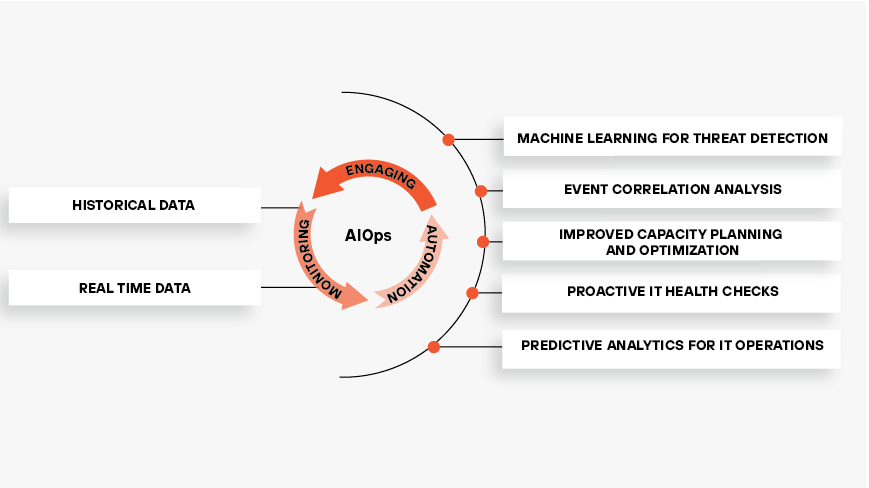
AIOps Practical Use Cases
Some practical AIOps use cases include machine learning for threat detection, event correlation analysis, improved capacity planning and optimization, proactive IT health checks, and predictive analytics for IT operations.
Machine Learning in Threat Detection
Machine learning is a robust cybersecurity threat detection tool because it analyzes vast amounts of data and identifies patterns that may not be apparent through traditional rule-based approaches.
Machine learning models can be trained on large datasets of known cyberthreats, such as malware samples, phishing emails, or network intrusion attempts. These models learn to recognize the characteristics and behaviors associated with malicious activities. When applied to incoming data, such as network traffic or email content, algorithms can flag suspicious activities based on their similarity to known threats.
In addition, machine learning excels at anomaly detection. It can establish a baseline of normal behavior by analyzing historical data. Machine learning algorithms can trigger alerts when deviations from this baseline occur, which could indicate an unusual or potentially malicious activity. This approach is particularly effective at identifying novel threats or zero-day attacks that lack predefined signatures.
Machine learning also enhances threat detection by continuously adapting to evolving threats. As new attack techniques and malware variants emerge, machine learning models can be updated and retrained to detect these emerging threats, providing a proactive and adaptable defense against a wide range of cybersecurity threats.
Event Correlation
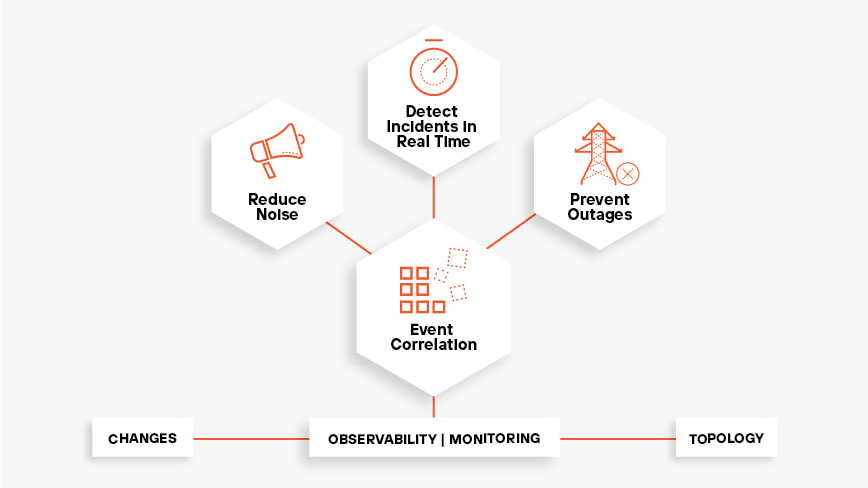
By analyzing and interpreting the vast amounts of data generated by IT systems and applications, AIOps improves event correlation.
The AIOps platform automatically aggregates and correlates events from various sources, such as logs, metrics, and monitoring tools, ensuring that IT operations are viewed in a unified and comprehensive manner. Algorithms identify patterns and relationships between these events, providing IT teams with an understanding of how they relate to one another.
AIOps also assists in prioritizing alerts and events based on their potential impact on IT operations. To minimize alert fatigue, AIOps considers the context and dependencies between events to identify the most critical issues that require immediate attention.
Furthermore, AIOps analyzes root causes by tracing the cause-and-effect relationships between events. This streamlines troubleshooting and speeds up incident resolution by pinpointing the underlying issues. AIOps enhances IT operations' efficiency and improves system reliability by automating event correlation and providing actionable insights.
Capacity Planning and Optimization
By leveraging artificial intelligence and machine learning, AIOps helps organizations allocate resources more efficiently and save money by analyzing historical and present-day data.
Using algorithms, AIOps analyzes past resource utilization patterns, application performance, and workload fluctuations. AIOps provides organizations valuable insight into capacity planning by identifying trends and forecasting future resource needs. As a result, they can allocate the correct amount of resources to meet current and future demand while avoiding over-provisioning, which can result in unnecessary costs or under-provisioning, leading to performance bottlenecks.
The AIOps platform also facilitates real-time optimization of resources by continuously monitoring the system's performance. AIOps can automatically scale resources up or down when it detects fluctuations in resource demand or potential bottlenecks. By dynamically scaling IT environments, performance and cost are optimized.
AIOps also optimizes cost by recommending the most cost-effective cloud instance types, pricing models, or data center strategies based on historical and real-time data. The AIOps approach to capacity planning and resource optimization helps organizations simplify their IT operations, reduce operational costs, and align their infrastructure with business needs.
Proactive IT Ops Health Checks
With AIOps, IT operations are transformed from reactive to proactive by automating health checks and enabling predictive analytics. It continuously monitors server, network, application, and database health and performance.
AIOps establishes a baseline of normal behavior by collecting and analyzing real-time metrics. AIOps can generate proactive alerts when deviations or anomalies are detected, allowing IT teams to address potential issues before they escalate. As a result, system reliability is improved, and downtime is minimized.
Predictive Analytics
Machine learning is used in AIOps to predict future trends and issues. It uses historical data to make informed forecasts about resource utilization, potential capacity limitations, and performance degradation.
IT teams can take preventive measures, like scaling resources, performing maintenance, or optimizing performance, when AIOps detects patterns and correlations in the data. Predictive analytics powered by AIOps enables organizations to stay ahead of problems, optimize their IT environments, and ensure uninterrupted service delivery.
AIOps can integrate seamlessly with ITSM (IT Service Management) systems, automating the creation of incident tickets and initiating predefined workflows when potential issues are identified. AIOps enables IT teams to proactively monitor, predict, and respond to IT infrastructure issues, improving operational health, enhanced service reliability, and cost savings.
Why Do AIOps Tools Matter?
AIOps tools matter significantly in today's complex and rapidly evolving IT landscape for several reasons:
- Automation and efficiency: From event correlation and alert management to incident resolution and resource provisioning, AIOps tools automate many IT operations tasks. AIOps tools improve IT team efficiency by automating manual and time-consuming processes, resulting in faster incident response times, lower operational costs, and better resource allocation. Automating IT tasks allows IT professionals to focus on strategic initiatives rather than monotonous, repetitive activities.
- Real-time insights: AIOps provide tools for real-time insight into IT systems and applications. Machine learning algorithms enable IT teams to continuously identify anomalies and trends, often before end users notice something wrong. AIOps tools continuously monitor logs, metrics, and events, enabling IT to identify issues proactively, often before they cause any problems to end users. Additionally, real-time insights enable organizations to identify the root causes of incidents quickly and reduce downtime.
- Scalability and adaptability: Scalability and adaptability are crucial in today's dynamic IT environments. IT infrastructure and data volumes grow, and AIOps tools can seamlessly scale to meet these demands. By continuously learning from new data and updating their models, they can adapt to evolving technologies and threats. Adaptability ensures AIOps tools remain effective in changing IT landscapes, including cloud services, containerization, and emerging technologies.
- Predictive analytics: Using predictive analytics, AIOps tools forecast future issues and trends. They can predict potential capacity constraints, performance bottlenecks, and security threats, enabling organizations to prevent problems before they arise through resource optimization, capacity planning, and security enhancements. Predictive analytics helps organizations maintain system reliability, reduce downtime, and save costs.
Benefits of AIOps Solutions
AIOps offers several significant benefits that enhance IT operations and contribute to the overall efficiency and effectiveness of organizations. These benefits include improved IT service reliability, proactive issue resolution, efficient resource management, automation-driven workflows, and data-driven decision-making.
- Proactive issue resolution: Through AIOps, organizations can detect and resolve IT issues before they impact end users or critical services. Analyzing data continuously from multiple sources allows AIOps to identify anomalies and trends. As a result of this early detection, downtime is minimized, service disruptions are reduced, and the reliability of IT services is improved. Proactive issue resolution enhances the user experience by ensuring IT systems operate smoothly.
- Efficient resource management: With AIOps, resource allocation and utilization are optimized, which is especially useful in cloud-based and dynamic IT environments. Data mining algorithms use historical and real-time data to predict resource needs accurately, preventing organizations from over-provisioning, which can be costly, and under-provisioning, which can cause performance problems. Managing resources efficiently in the cloud and on-premises results in cost savings, improved performance, and improved cost control.
- Automation and workflow streamlining: AIOps automates routine IT operations tasks such as alert management, event correlation, and incident response. Automation reduces manual workloads, minimizes human error, and speeds up incident resolution. AIOps can be integrated with ITSM systems to initiate workflows, create incident tickets, and route issues to the appropriate teams. Through this streamlining of processes, AIOps can achieve a faster mean time to resolution (MTTR) and greater operational efficiency.
- Data-driven decision-making: AIOps provides organizations with data-driven insights and analytics that help them make strategic decisions. Using it, organizations can make informed decisions about capacity planning, resource investments, and infrastructure optimization based on an IT performance and health overview. Organizations can use predictive analytics to plan for the future and mitigate potential risks. Data-driven decision-making improves IT operations and enhances business agility and competitiveness.
The advantages of AIOps make it an essential component of modern IT operations, helping organizations stay competitive, reduce operational overhead, and improve user experience.
AIOps Use Cases FAQs
AIOps, short for artificial intelligence for IT operations, is an approach that combines artificial intelligence, machine learning, data analysis, automation, visualization, and insights with traditional IT operations processes to enhance management and monitoring of IT systems and infrastructure.
Practical AIOps use cases include machine learning for threat detection, event correlation analysis, improved capacity planning and optimization, proactive IT health checks, and predictive analytics for IT operations.
AIOps empowers IT teams to drive innovation, reduce mean time to repair, streamline IT operations, prevent outages, and optimize business outcomes.
The AIOps benefits for IT operations include improved service reliability, proactive issue resolution, efficient resource management, automation-driven workflows, and data-driven decision-making.
AIOps automatically aggregates and correlates events from various sources, such as logs, metrics, and monitoring tools, ensuring that IT operations are viewed in a unified and comprehensive manner.


